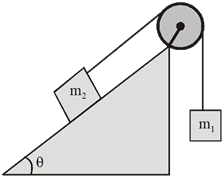
In the figure shown, if coefficient of friction is , then m2 will start moving upwards if:
Physics · JEE Main · NTA Exams — Laws of Motion
In the figure shown, if coefficient of friction is \(\mu\), then m2 will start moving upwards if:
- \(\frac{m_{1}}{m_{2}}>\sin \theta-\mu \cos \theta\)
- \(\frac{m_{1}}{m_{2}}>\sin \theta+\mu \cos \theta\)
- \(\frac{m_{1}}{m_{2}}>\mu \sin \theta-\cos \theta\)
- \(\frac{m_{1}}{m_{2}}>\mu \sin \theta+\cos \theta\)
Answer
(B) m_ 1 m_ 2 > +
Sign up free on Edukali to view the step-by-step worked solution and practice thousands of similar questions.
Related practice questions
- Consider the shown arrangement. Assume all surfaces to be smooth. If N represents magnitudes of normal…
- A rope of length L and mass M is hanging from a rigid support. The tension in the rope at a distance x from…
- A uniform metal rod of length 1 m is bent at 90° so as to form two arms of equal length. The centre of mass…
- In the above problem, if a push of 5 N is applied on the lighter mass, the force exerted by the lighter mass…
- A block A of mass 7 kg is placed on a frictionless table. A thread tied to it passes over a frictionless…
- Three balls A, B and C (m_ A =m_ C =4 m_ B ) are placed on a smooth horizontal surface. Ball B collides with…
- A block of mass 4 kg is placed on a rough horizontal plane. A time dependent force F = kt2 acts on the block…
- A body of mass m is acted upon by a force F and the acceleration produced is a. If three forces each equal to…
More Laws of Motion questions · Browse all practice questions