The figure shows the motion of a planet around the sun in an elliptical orbit with sun at…
Physics · JEE Advanced · NTA Exams — Gravitation
The figure shows the motion of a planet around the sun in an elliptical orbit with sun at the focus. The shaded areas A and B are also shown in the figure which can be assumed to be equal. If \(t_{1}\) and \(t_{2}\) represent the time for the planet to move from a to b and d to c respectively, then
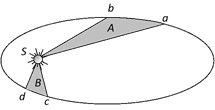
- \(t_{1}
- \(t_{1}>t_{2}\)
- \(t_{1}=t_{2}\)
- \(t_{1} \neq t_{2}\)
Answer
(C) t_ 1 =t_ 2
Sign up free on Edukali to view the step-by-step worked solution and practice thousands of similar questions.
Related practice questions
- A geo-stationary satellite orbits around the earth in a circular orbit of radius 36,000 km. Then, the time…
- The distance of the centres of moon and earth is D. The mass of earth is 81 times the mass of the moon. At…
- A solid sphere of uniform density and radius R applies a gravitational force of attraction equal to F 1 on a…
- A rocket is launched normal to the surface of the Earth, away from the Sun, along the line joining the Sun…
- In the graph shown, the PE of earth-satellite system is shown by solid line as a function of distance r (the…
- Statement-1: A spherically symmetric shell produces no gravitational field anywhere. Statement-2: The field…
- Statement - 1: Escape velocity is independent of the angle of projection. Statement - 2: Escape velocity from…
- The satellites when launched from earth are not given the orbital velocity initially, in practice, a…