If y = l og a x + l og x a + l og x x + l og a a, then dy dx is equal to
Mathematics · JEE Main · NTA Exams — Limit, Continuity and Differentiability
If y = loga x + logx a + logx x + loga a, then \(\frac{\mathrm{dy}}{\mathrm{dx}}\) is equal to
- \(\frac{1}{x}+x \log a\)
- \(\frac{\log a}{x}+\frac{x}{\log a}\)
- \(\frac{1}{x \log a}+x \log a\)
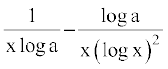
Answer
(D)
Sign up free on Edukali to view the step-by-step worked solution and practice thousands of similar questions.
Related practice questions
- Consider a function f( x )= ( - 1 - x ) (4 – 3x 2 ) where ‘α’ is a positive parameter Absolute difference…
- _ n 1 2 + 1 2^ 2 + 1 2^ 3 + + 1 2^ n equals
- _ x 4 x (4 x) ^ 2 x ^ 2 (2 x) is equal to:
- _ x 0 e^ 1 x -1 e^ 1 x +1 =
- The points on the curve y = x 1- x ^ 2 –1 < x < 1 at which the tangent line is vertical are
- Given below are two statements. One is labelled as Assertion and the other is labelled as Reason. STATEMENT …
- The value of _ x [ x+ x+ x - x ] is
- For function f ( x )= n x x which of the following statements are true.
More Limit, Continuity and Differentiability questions · Browse all practice questions