A ball A of mass m is given an initial velocity to slide down and collide with ball B of…
Physics · JEE Advanced · NTA Exams — Laws of Motion
A ball A of mass m is given an initial velocity to slide down and collide with ball B of mass (2m) so that ball B now has sufficient energy just to hit ball at C. As the ball A slides down its velocity becomes twice of its initial velocity before collision. The coefficient of restitution is (1/2) :
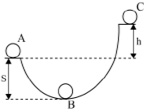
- the velocity of ball B after collision is \([2 \sqrt{g(h+s)}]\)
- the velocity of ball B after collision is \(\sqrt{2 g(h+s)} .\)
- the initial velocity of ball A is \(\sqrt{2 g(h+s)} .\)
- the initial velocity of ball A is \(2 \sqrt{g(h+s)} .\)
Answer
(B) the velocity of ball B after collision is 2 g(h+s) ., (C) the initial velocity of ball A is 2 g(h+s) .
Sign up free on Edukali to view the step-by-step worked solution and practice thousands of similar questions.
Related practice questions
- A circular ring of mass 6 kg and radius a is placed such that its centre lies at the origin. Two particles of…
- A bullet of mass 0.01 kg and travelling at a speed of 500 m/s strikes a block of mass 2 kg, which is…
- A student performs two experiments to determine the coefficient of static and kinetic friction between a…
- A stationary body explodes into four identical fragments such that three of them fly off mutually…
- A pendulum bob of mass m connected to the end of an ideal string of length l is released from rest from…
- Statement – 1: If no external force acts on a system of particles, then the centre of mass will not move in…
- When a bird of weight W sits on a stretched wire, the tension T in the wire is
- A block of weight 5 N is pushed against a vertical wall by a force of 12 N. The coefficient of friction…
More Laws of Motion questions · Browse all practice questions