ABCD is a trapezium such that AB and CD are parallel and BC ⊥ CD. If ∠ADB = θ, BC = p and…
Mathematics · JEE Main · NTA Exams — Trigonometry
ABCD is a trapezium such that AB and CD are parallel and BC ⊥ CD. If ∠ADB = θ, BC = p and CD = q, then AB is equal to
- \(\frac{\left(p^{2}+q^{2}\right) \sin \theta}{p \cos \theta+q \sin \theta}\)
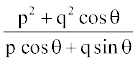
- \(\frac{p^{2}+q^{2}}{p^{2} \cos \theta+q^{2} \sin \theta}\)
- \(\frac{\left(p^{2}+q^{2}\right) \sin \theta}{(p \cos \theta+q \sin \theta)^{2}}\)
Answer
(A) (p^ 2 +q^ 2 ) p +q
Sign up free on Edukali to view the step-by-step worked solution and practice thousands of similar questions.
Related practice questions
- The value of ^ -1 [ 1+x^ 2 + 1-x^ 2 1+x^ 2 - 1-x^ 2 ], |x|< 1 2 , x 0, is equal to
- The sum of the radii of inscribed and circumscribed circles for an n sided regular polygon of side a, is
- (2 ^ -1 1 5 + ^ -1 5 2 +2 ^ -1 1 8 ) is equal to
- A bird is sitting on the top of a vertical pole 20 m high and its elevation from a point O on the ground is…
- The value of 2+ 2+ 2+2 8 . where 0< < 8 is equal to
- Given that the inverse trigonometric function assumes principal values only. Let x , y be any two real…
- cosec [2 ^ -1 (5)+ ^ -1 ( 4 5 ) ] is equal to
- If 0<x< 1 2 and ^ -1 x = ^ -1 x , then a value of ( 2 + ) is