Let f : [0, 1] → R (the set of all real numbers) be a function. Suppose the function f is…
Mathematics · JEE Advanced · NTA Exams — Limit, Continuity and Differentiability
Let f : [0, 1] → R (the set of all real numbers) be a function. Suppose the function f is twice differentiable, f (0) = f (1) = 0 and satisfies f ′′(x) – 2f ′(x) + f (x) ≥ ex, x ∈ [0, 1].
If the function e–x f(x) assumes its minimum in the interval [0, 1] at x = 1/4, which of the following is true?
If the function e–x f(x) assumes its minimum in the interval [0, 1] at x = 1/4, which of the following is true?
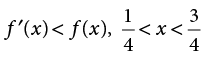
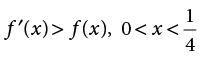
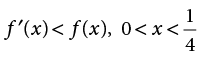
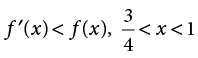
Answer
(C)
Sign up free on Edukali to view the step-by-step worked solution and practice thousands of similar questions.
Related practice questions
- The limit of sequence 2 , 2 2 , 2 2 2 ....... is
- Let f(x)= x x^ 2 , x>0 Let x 1 x 2 x 3 ..... x n f and y 1 y 2 y 3 y n f . Then which of the following…
- The value of _ x 0 1 x^ 3 _ 0 ^ x t (1+t) t^ 4 +4 d t is
- If x + | y |= 2 y , then y as a function of x is
- The function f(x)= array ll |x-3| & , x 1 x^ 2 4 - 3 x 2 + 13 4 & , x<1 array . .
- Let y = x 3 – 8x + 7 and x = f (t). If dy dt = 2 and x = 3 at t = 0, then dx dt at t = 0 is given by
- If y = | array ccc x & x & x x & - x & x x & 1 & 1 array | , then dy dx is equal to
- Let f : [ a , b ] → [1, ∞) be a continuous function and let g : R → R be defined as g(x)= array llc 0 & if &…
More Limit, Continuity and Differentiability questions · Browse all practice questions