In the given figure vertices of ∆ ABC lie on y = f (x) = ax 2 + bx + c. The ∆ ABC is…
Mathematics · JEE Advanced · NTA Exams — Complex Numbers and Quadratic Equations
In the given figure vertices of ∆ ABC lie on y = f (x)
= ax2 + bx + c. The ∆ ABC is right angled isosceles triangle whose hypotenuse AC = \(4 \sqrt{2}\) units, then
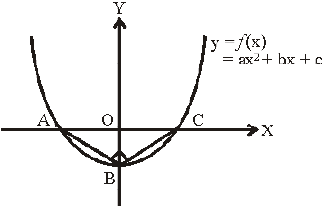
y = f (x) is given by
- \(y=\frac{x^{2}}{2 \sqrt{2}}-2 \sqrt{2}\)
- \(y=\frac{x^{2}}{2}-2\)
- y = x2 – 8
- \(y=x^{2}-2 \sqrt{2}\)
Answer
(A) y= x^ 2 2 2 -2 2
Sign up free on Edukali to view the step-by-step worked solution and practice thousands of similar questions.
Related practice questions
- The maximum integral part of positive value of a for which, the least value of 4x 2 – 4 a x + a 2 – 2 a + 2…
- Equation has
- If α, β are the roots of ax 2 + bx + c = 0 and α + β, α 2 + β 2 , α 3 + β 3 are in G.P. and ∆ = b 2 – 4 ac …
- If z 1 and z 2 are two complex numbers satisfying the equation | z_ 1 +i z_ 2 z_ 1 -i z_ 2 |=1 , then z_ 1 z_…
- If α, β, γ, δ are the roots of the equation, x 4 – Kx 3 + Kx 2 + Lx + M = 0 where K, L and M are real numbers…
- If α, β are the roots of the quadratic equation, x 2 – 2p (x – 4) – 15 = 0 then the set of values of p for…
- If a, b, p, q are non-zero real numbers, the two equations, 2 a 2 x 2 – 2 abx + b 2 = 0 and p 2 x 2 + 2 pqx +…
- If a , b , c , d are positive real numbers such that a + b + c + d = 2, then M = ( a + b ) ( c + d )…
More Complex Numbers and Quadratic Equations questions · Browse all practice questions