For an ideal gas, consider only P-V work in going from an initial state X to the final…
Chemistry · JEE Advanced · NTA Exams — Chemical Thermodynamics
For an ideal gas, consider only P-V work in going from an initial state X to the final state Z. The final state Z can be reached by either of the two paths shown in the figure. Which of the following choice(s) is(are) correct? [Take ΔS as change in entropy and w as work done]
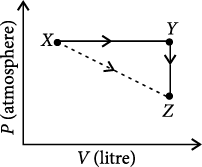
- DSX→Z = DSX→Y + DSY→Z
- wX→Z = wX→Y + wY→Z
- wX→Y →Z = wX→Y
- DSX→Y→Z = DSX→Y
Answer
(A) D S X → Z = D S X → Y + D S Y → Z
Sign up free on Edukali to view the step-by-step worked solution and practice thousands of similar questions.
Related practice questions
- Spontaneous adsorption of a gas on solid surface is an exothermic process because (2004)
- 2 mole of an ideal monoatomic gas undergoes a reversible process for which PV 2 = C. The gas is expnaded from…
- Which of the following reactions defines ∆Hº f ? (2003)
- Assertion (A) : Enthalpy of neutralization of CH 3 COOH by NaOH is less than that of HCl by NaOH. Reason (R)…
- Consider the reaction below at 298 K : C (graphite) + 2H 2 (g) → CH 4 (g) ∆ f Hº (kJ/mol) = 74.9 S 0 m…
- ∆ r H 0 for solid-to-liquid transition for proteins A and B are 2.73 kcal mol –1 and 3.03 kcal mol –1 . The…
- Assertion (A) : There is no change in internal energy for an ideal gas at constant temperature. Reason (R) …
- Two moles of ideal helium gas are in a rubber balloon at 30°C. The balloon is fully expandable and can be…
More Chemical Thermodynamics questions · Browse all practice questions