A long straight wire carries a current, I = 2 ampere. A semi-circular conducting rod is…
Physics · JEE Advanced · NTA Exams — Electromagnetic Induction and Alternating Currents
A long straight wire carries a current, I = 2 ampere. A semi-circular conducting rod is placed beside it on two conducting parallel rails of negligible resistance. Both the rails are parallel to the wire. The wire, the rod and the rails lie in the same horizontal plane, as shown in the figure. Two ends of
the semi-circular rod are at distances 1 cm and 4 cm from the wire. At time t = 0, the rod starts moving on the rails with a speed v = 3.0 m s–1 (see the figure).
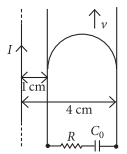
A resistor R =1.4 Ω and a capacitor C0 = 5.0 μF are connected in series between the rails. At time t = 0, C0 is uncharged. Which of the following statement(s) is(are) correct?
[μ0 = 4π × 10−7 SI units. Take ln2 = 0.7]
the semi-circular rod are at distances 1 cm and 4 cm from the wire. At time t = 0, the rod starts moving on the rails with a speed v = 3.0 m s–1 (see the figure).
A resistor R =1.4 Ω and a capacitor C0 = 5.0 μF are connected in series between the rails. At time t = 0, C0 is uncharged. Which of the following statement(s) is(are) correct?
[μ0 = 4π × 10−7 SI units. Take ln2 = 0.7]
- Maximum current through R is 1.2 ×10⁻⁶ ampere.
- Maximum current through R is 3.8 × 10⁻⁶ ampere.
- Maximum charge on capacitor C0 is 8.4 × 10⁻¹² coulomb.
- Maximum charge on capacitor C0 is 2.4 ×10⁻¹² coulomb.
Answer
(B) Maximum current through R is 3.8 × 10 −6 ampere.
Sign up free on Edukali to view the step-by-step worked solution and practice thousands of similar questions.
Related practice questions
- A conducting rod of length l is hinged at point O. It is free to rotate in a vertical plane. There exists a…
- Some magnetic flux is changed from a coil of resistance 10 ohm . As a result an induced current is developed…
- A conducting rod of length 2 l is rotating with constant angular speed ω about its perpendicular bisector. A…
- The SI unit of inductance, the henry can be written as
- The figure shows certain wire segments joined together to form a coplanar loop. The loop is placed in a…
- In the figure shown R is a fixed conducting ring of negligible resistance and radius ‘a’. PQ is a uniform rod…
- A conducting wire of parabolic shape, y = x 2 , is moving with velocity V =V_ 0 i in a non-uniform magnetic…
- A conducting square loop initially lies in the XZ plane with its lower edge hinged along the X -axis. Only in…
More Electromagnetic Induction and Alternating Currents questions · Browse all practice questions