A open ended mercury manometer is used to measure the pressure exerted by a trapped gas…
Chemistry · JEE Advanced · NTA Exams — States of Matter (Gases and Liquids)
A open ended mercury manometer is used to measure the pressure exerted by a trapped gas as shown in the figure. Initially manometer shows no difference in mercury level in both columns as shown in diagram.
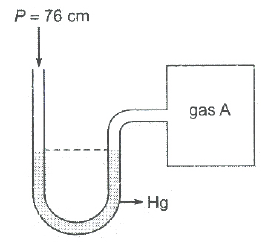
After sparking ‘A’ dissociated according to following reaction
\(\mathrm{A}(\mathrm{~g}) \longrightarrow \mathrm{B}(\mathrm{~g})+3 \mathrm{C}(\mathrm{~g})\)
If pressure of Gas “A” decreases to 0.9 atm. Then (Assume temperature to be constant and is 300 K)
After sparking ‘A’ dissociated according to following reaction
\(\mathrm{A}(\mathrm{~g}) \longrightarrow \mathrm{B}(\mathrm{~g})+3 \mathrm{C}(\mathrm{~g})\)
If pressure of Gas “A” decreases to 0.9 atm. Then (Assume temperature to be constant and is 300 K)
- total pressure increased to 1.3 atm
- total pressure increased by 0.3 atm
- total pressure increased by 22.3 cm of Hg
- difference in mercury level is 228 mm.
Answer
(B) total pressure increased by 0.3 atm, (D) difference in mercury level is 228 mm.
Sign up free on Edukali to view the step-by-step worked solution and practice thousands of similar questions.
Related practice questions
- NH 3 can be liquefied at ordinary temperature without the application of pressure. But O 2 cannot, because
- The graph of P vs V is given at different temperatures and number of moles The correct relationship are
- The critical temperature of water is higher than that of O 2 because the H 2 O molecule has (1997)
- Consider the adjacent diagram to answer these questions : Initially, flask A contained oxygen gas at 27ºC and…
- The vapour density of a gas is 11.2. The volume occupied by 11.2 g of this gas at N.T.P. is
- Assertion (A): For a given amount of an ideal gas, a plot of pressure (p) versus (1/V) is a straight line at…
- Assertion (A): The gases He and H 2 are very different in their behaviour at any temperature and pressure but…
- Densities of two gases having same molar mass are in the ratio 1 : 2 and their temperatures are in the ratio…
More States of Matter (Gases and Liquids) questions · Browse all practice questions