A mass m moves with a velocity v and collides inelastically with another identical mass…
Physics · JEE Advanced · NTA Exams — Laws of Motion
A mass m moves with a velocity v and collides inelastically with another identical mass. After collision the Ist mass moves with velocity \(\frac{\mathrm{v}}{\sqrt{3}}\) in a direction perpendicular to the initial direction of motion. Find the speed of the 2nd mass after collision :
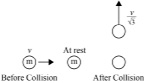
- \(\frac{2}{\sqrt{3}} \mathrm{v}\)
- \(\frac{\mathrm{v}}{\sqrt{3}}\)
- v
- \(\sqrt{3} v\)
Answer
(A) 2 3 v
Sign up free on Edukali to view the step-by-step worked solution and practice thousands of similar questions.
Related practice questions
- The entire mass of a system is assumed to be concentrated at a point, which we call the centre of mass. Such…
- In the figure, the blocks A, B and C of mass m each have acceleration a_ 1 , a_ 2 and a_ 3 respectively. F_ 1…
- Two masses m and M are attached with strings as shown. For the system to be in equilibrium we have:
- Assertion: A reference frame attached to the earth is an inertial frame of reference. Reason: Newton's laws…
- In a two block system an initial velocity v 0 with respect to ground is given to block A :
- A rough vertical board has an acceleration a along the horizontal, so that a block of mass M pressing against…
- A particle A of mass m initially at rest slides down a height of 1.25 m on a frictionless ramp, collides with…
- The entire mass of a system is assumed to be concentrated at a point, which we call the centre of mass. Such…
More Laws of Motion questions · Browse all practice questions