Let f ( x ) be a non-constant twice differentiable function defined on (–∞, ∞) such that…
Mathematics · JEE Advanced · NTA Exams — Limit, Continuity and Differentiability
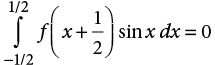
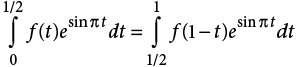
Let f(x) be a non-constant twice differentiable function defined on (–∞, ∞) such that f (x) = f (1 – x) and \(f^{\prime}\left(\frac{1}{4}\right)=0\) Then,
- f

Answer
(A) f ″ ( x ) vanishes at least twice on [0, 1]
Sign up free on Edukali to view the step-by-step worked solution and practice thousands of similar questions.
Related practice questions
- Let S be the set of all (α, β) ∈ × such that _ x (x^ 2 ) ( _ e x )^ ( 1 x^ 2 ) x^ ( _ e (1+x) )^ =0 Then…
- The value of _ x 0 1 x^ 3 _ 0 ^ x t (1+t) t^ 4 +4 d t is
- Let f(x)=x^ n , n ~W . The number of values of n for which f^ (p+q)=f^ (p)+f^ (q) is valid for all +ve p & q…
- Let f (x) = sin x, g (x) = 2x and h (x) = cos x. If φ (x) = [go (f h)] (x), then φ “ ( 4 ) is equal to
- Let f(x)= x x^ 2 , x>0 Let x 1 x 2 x 3 ..... x n f and y 1 y 2 y 3 y n f . Then which of the following…
- If y 2 = P (x), a polynomial of degree n 3, then 2 d d x (y^ 3 d^ 2 y d x^ 2 )
- Consider two functions f (x) = _ n ( x n )^ n and g(x) = –x 4b where b = _ x ( x^ 2 +x+1 - x^ 2 +1 ) Then. f…
- Let f (x) = a [x] + b e |x| + c |x| 2 , where a, b and c are real constants. where [x] denotes greatest…
More Limit, Continuity and Differentiability questions · Browse all practice questions