The dependence of rate on concentrations of reactants is expressed in terms of rate law…
Chemistry · JEE Advanced · NTA Exams — Chemical Kinetics
The dependence of rate on concentrations of reactants is expressed in terms of rate law, which is established experimentally.
\(\text { Rate }=\mathrm{k}[\mathrm{~A}]^{\mathrm{a}}[\mathrm{~B}]^{\mathrm{b}}\) (Rate law) ..........(i)
The exponents a, b, etc. (determined experimentally) may or may not be equal to the respective stoichiometric coefficients. k is the velocity constant of the reaction. The determination of rate law is simplified by the isolation method in which the concentration of all the reactants except one are in large excess. If B is in large excess. we can approximate [B]by \([\mathrm{B}]_{0}\)
Hence, \(\text { Rate }=\mathrm{k}[\mathrm{~A}]^{\mathrm{a}}[\mathrm{~B}]^{\mathrm{b}}=\mathrm{k}[\mathrm{~A}]^{\mathrm{a}}[\mathrm{~B}]_{\mathrm{b}}^{\mathrm{b}}=\mathrm{k}^{\prime}[\mathrm{A}]^{\mathrm{a}}\) \(\left(\mathrm{k}^{\prime}=\mathrm{k}[\mathrm{~B}]_{0}^{\mathrm{b}}\right)\)
or \(\log (\text { initialrate })=\log\) \(\mathrm{v}_{0}=\log \mathrm{k}^{\prime}+\mathrm{a} \log [\mathrm{~A}]\) ...... (ii)
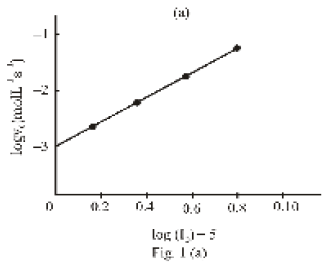
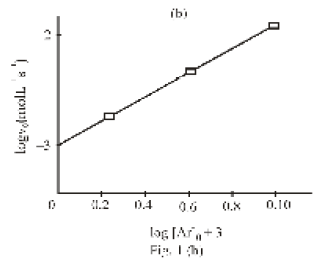
A plot of log (rate) against \(\log [\mathrm{A}]\) values will be a straight line which enables to calculate both \(\mathrm{k}^{\prime}\) and a. Similarly orders with respect to other reactants. taken in much smaller concentrations turn by turn, can be determined. Consider the reaction : \(2 \mathrm{I}_{(\mathrm{g})}+\mathrm{A}_{(\mathrm{g})} \longrightarrow \mathrm{I}_{2(\mathrm{~g})}+\mathrm{A}_{(\mathrm{g})}\)
The following figures show the variation of log υ0 against (a ) \(\log \mathrm{I}_{0}\) for a given \([\mathrm{Ar}]_{0}\) and ( b) \(\log [\mathrm{Ar}]_{0}\) for a given \([\mathrm{I}]_{0}\)
The rate constants of most reactions increase as the temperature is increased. The rate constant increases by about \(100-200 \%\) for a temperature rise of \(10 \mathrm{~K}\). It is found experimentally for many reactions that a plot of \(\ell \mathrm{nk}\) against \(1 / T\) gives a straight line. This behaviour is expressed in the form of equation.
\(\ell \mathrm{n} \mathrm{k}=\ell \mathrm{n} \mathrm{~A}-\frac{\mathrm{E}_{\mathrm{a}}}{\mathbb{R}}\) .............. (iii)
The rate of change of molar concentration of C in Reaction – 1, is found to be 3.0 × 10⁻³ mol L–1s–1. The rate of reaction and rate of disappearance of the reactant B are respectively.
- 3.0 × 10⁻³ mol L–1s–1 each
- 1.0 × 10⁻³ mol L–1s–1 each
- 1.0 × 10⁻³ mol L–1s–1 and 2.0 × 10⁻³ mol L–1 s–1
- None of these.
Answer
(C) 1.0 × 10 –3 mol L –1 s –1 and 2.0 × 10 –3 mol L –1 s –1
Sign up free on Edukali to view the step-by-step worked solution and practice thousands of similar questions.
Related practice questions
- For the reaction A + B → C + D, the variation of the concentration of the product with time is given by the…
- For the hypothetical reaction A 2 + B 2 ⟶ 2AB, the mechanism is given as below A 2 A + A(fast reaction) A + B…
- Carbon-14 is used to determine the age of organic material. The procedure is based on the formation of ^ 14 C…
- Under the same reaction conditions, initial concentration of 1.386 mol dm –3 of a substance becomes half in…
- What is the order of a reaction which has a rate expression rate = k [A] 3/2 [B] –1 ?
- An increase in the rate of reaction with rise in temperature is due to
- T 50 of first-order reaction is 10 min. Starting with 10 mol L –1 , rate after 20 min is (2008)
- The specific rate constant of a first order reaction depends on the
More Chemical Kinetics questions · Browse all practice questions