Let w = cos and α = w + w 2 + w 4 and β = w 3 + w 5 + w 6 . 2α equals :
Mathematics · JEE Advanced · NTA Exams — Complex Numbers and Quadratic Equations
Let w = cos
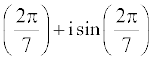 and α = w + w2 + w4 and
 β = w3 + w5 + w6.
2α equals :
- \(-1+\sqrt{7} i\)
- \(-1-\sqrt{7} \mathrm{i}\)
- 1 + 7i
- 1 – 7i
Answer
(A) -1+ 7 i
Sign up free on Edukali to view the step-by-step worked solution and practice thousands of similar questions.
Related practice questions
- For a > 0, the roots of the equation l og ax a + l og x a 2 + l og a 2 x a 3 = 0, are given by
- If b 1 and x 2 of the equation 2x 2 + 6x + b = 0, satisfy the condition ( x_ 1 x_ 2 )+ ( x_ 2 x_ 1 ) < k…
- The area of the triangle whose vertices are i, α, β, where i= -1 and α, β are the non-real cube roots of…
- If z = re i θ , then | i iz | is equal to
- b > 0 and θ ∈ (–π, π], then the value of θ is
- In the given figure vertices of ∆ ABC lie on y = f (x) = ax 2 + bx + c. The ∆ ABC is right angled isosceles…
- Equation has
- The maximum integral part of positive value of a for which, the least value of 4x 2 – 4 a x + a 2 – 2 a + 2…
More Complex Numbers and Quadratic Equations questions · Browse all practice questions