Let x 0 be the real number such that e x 0 + x 0 = 0 . For a given real number α, define…
Mathematics · JEE Advanced · NTA Exams — Limit, Continuity and Differentiability
Let x0 be the real number such that ex0 + x0 = 0 . For a given real number α, define \(g(x)=\frac{3 x e^{x}+3 x-\alpha e^{x}-\alpha x}{3\left(e^{x}+1\right)}\)for all real numbers x.
Then which one of the following statements is TRUE?
Then which one of the following statements is TRUE?
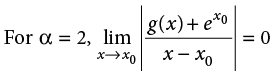
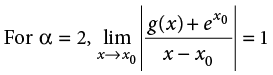
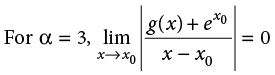
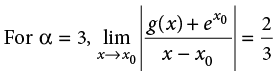
Answer
(C)
Sign up free on Edukali to view the step-by-step worked solution and practice thousands of similar questions.
Related practice questions
- Let for all x > 0 . Then
- If f (n + 1) = 1 2 f( n )+ 9 f( n ) , n ∈ N and f (n) > 0 for all n ∈ N then _ n f (n) is equal to
- A curve y = f ( x ) passes through (1, 1) and tangent at P ( x , y ) cuts the x -axis and y axis at A and B…
- If f ( x ) = x n , then the value of f(1)- f^ (1) 1! + f^ (1) 2! - f^ (1) 3! + + (-1)^ n f^ n (1) n! is
- Let f be the differentiable for ∀ x . If f (1) = –2 and f ′( x ) ≥ 2 for [1, 6], then
- Limit _ x 3 (x^ 3 +27 ) (x-2) (x^ 2 -9 ) =
- If f (x) = l og | 2x |, x ≠ 0, then f ′ (x) is equal to
- If Lim _ x 0 x^ 3 a+x (b x- x) =1, a > 0, then a + 2b is equal to
More Limit, Continuity and Differentiability questions · Browse all practice questions