Particles P and Q of masses 20 g and 40 g respectively are projected from positions A and…
Physics · JEE Advanced · NTA Exams — Laws of Motion
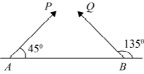
Particles P and Q of masses 20 g and 40 g respectively are projected from positions A and B on the ground. The initial velocities of P and Q make angles of 45° and 135°, repectively with the horizontal as shown. Each particle has an initial speed of 49 m/s. The separation AB is 245 m. Both particles travel in the same vertical plane and undergo a collision. After the collision P retraces its path. The position of Q when it hits the ground is
- 245 m
- \(\frac{245}{3} \mathrm{~m}\)
- \(\frac{245}{2} \mathrm{~m}\)
- \(\frac{245}{\sqrt{2}} \mathrm{~m}\)
Answer
(C) 245 2 ~m
Sign up free on Edukali to view the step-by-step worked solution and practice thousands of similar questions.
Related practice questions
- A block of mass 0.1 kg is held against a wall applying a horizontal force of 5 N on the block. If the…
- Statement-1 : A block of mass m starts moving on a rough horizontal surface with a velocity v . It stops due…
- A ball A of mass m is given an initial velocity to slide down and collide with ball B of mass (2m) so that…
- A block of mass 0.1 kg is held against a wall by applying a horizontal force of 5 N on the block. If the…
- A body A of mass 2 kg is projected upward from the surface of the ground at t = 0 with a velocity of 20 m/s…
- A man of mass m moves with a constant speed on a plank of mass M and length l kept initially at rest on a…
- An object comprises of a uniform ring of radius R and its uniform chord AB (not necessarily made of the same…
- A cannon ball is fired with a velocity 200 m/s at an angle of 60° with the horizontal. At the highest point…
More Laws of Motion questions · Browse all practice questions