A reversible cyclic process for an ideal gas is shown below, Here, P, V, and T are…
Chemistry · JEE Advanced · NTA Exams — Chemical Thermodynamics
A reversible cyclic process for an ideal gas is shown below, Here, P, V, and T are pressure, volume and temperature, respectively. The thermodynamic parameters q, w, H and U are heat, work, enthalpy and internal energy, respectively.
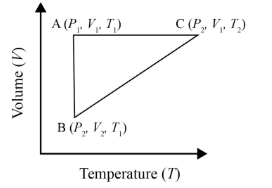
The correct option(s) is (are) (2018)
The correct option(s) is (are) (2018)
- qAC = \(\Delta \mathrm{U}_{\mathrm{BC}}\) and wAB = P2 (V2 – V1)
- \(\mathrm{w}_{\mathrm{BC}}=\mathrm{P}_{2}\left(\mathrm{~V}_{2}-\mathrm{V}_{1}\right) \text { and } \mathrm{q}_{\mathrm{BC}}=\Delta \mathrm{H}_{\mathrm{AC}}\)
- \(\Delta \mathrm{H}_{\mathrm{CA}}<\Delta \mathrm{U}_{\mathrm{CA}} \text { and } \mathrm{q}_{\mathrm{BC}}=\Delta \mathrm{H}_{\mathrm{AC}}\)
- \(\mathrm{q}_{\mathrm{BC}}=\Delta \mathrm{H}_{\mathrm{AC}} \text { and } \Delta \mathrm{H}_{\mathrm{CA}}>\Delta \mathrm{U}_{\mathrm{CA}}\)
Answer
(B) w _ BC = P _ 2 ( ~V _ 2 - V _ 1 ) and q _ BC = H _ AC, (C) H _ CA < U _ CA and q _ BC = H _ AC
Sign up free on Edukali to view the step-by-step worked solution and practice thousands of similar questions.
Related practice questions
- For the real gases reaction 2CO (g) + O 2 (g) → 2CO 2 (g) ∆H = –560 kJ. In 10 litre rigid vessel at 500 K the…
- Assertion (A) : Heat of neutralization of HF is more than that of HC l by NaOH. Reason (R) : HC l is stronger…
- What is the change in molar entropy of helium in the following process ? 1 He (298 K, 1 bar) → 1 He (100 K…
- Calculate _ f G ^ for (NH 4 Cl, s) at 310 K. Given : _ f H ^ (NH 4 Cl, s)= –314.5 kJ/mol; _ r C_ p =0 S _ N _…
- 1 mole of an ideal gas A (C v,m = 3 R) and 2 mole of an ideal gas B ( C _ v , ~m = 3 2 R ) are taken in a…
- Two moles of ideal helium gas are in a rubber balloon at 30°C. The balloon is fully expandable and can be…
- One mode of an ideal gas at 300 K in thermal contact with surroundings expands isothermally from 1.0 L to 2.0…
- An ideal gas undergoes a reversible isothermal expansion from state I to stable II followed by a reversible…
More Chemical Thermodynamics questions · Browse all practice questions