A special metal S conducts electricity without any resistance. A closed wire loop, made…
Physics · JEE Advanced · NTA Exams — Magnetic Effects of Current and Magnetism
A special metal S conducts electricity without any resistance. A closed wire loop, made of S, does not allow any change in flux through itself
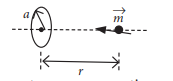
by inducing a suitable current to generate a compensating flux. The induced current in the loop cannot decay due to its zero resistance. This current gives rise to a magnetic moment which in turn repels the source of magnetic field or flux. Consider such a loop, of radius a, with its center at the origin. A magnetic dipole of moment m is brought along the axis of this loop from infinity to a point at distance r (>> a)
from the center of the loop with its north pole always facing the loop, as shown in the figure below.
The magnitude of magnetic field of a dipole m, at a point on its axis at distance r, is \(\frac{\mu_{0}}{2 \pi} \frac{m}{r^{3}}\), where μ0 is the permeability
of free space. The magnitude of the force between two magnetic dipoles with moments, m1 and m2, separated by a distance r on the common axis, with their north poles facing each other, is where k is a constant of appropriate dimensions. The direction of this force is along the line joining the two dipoles.
The work done in bringing the dipole from infinity to a distance r from the center of the loop by the given process is proportional to
by inducing a suitable current to generate a compensating flux. The induced current in the loop cannot decay due to its zero resistance. This current gives rise to a magnetic moment which in turn repels the source of magnetic field or flux. Consider such a loop, of radius a, with its center at the origin. A magnetic dipole of moment m is brought along the axis of this loop from infinity to a point at distance r (>> a)
from the center of the loop with its north pole always facing the loop, as shown in the figure below.
The magnitude of magnetic field of a dipole m, at a point on its axis at distance r, is \(\frac{\mu_{0}}{2 \pi} \frac{m}{r^{3}}\), where μ0 is the permeability
of free space. The magnitude of the force between two magnetic dipoles with moments, m1 and m2, separated by a distance r on the common axis, with their north poles facing each other, is
where k is a constant of appropriate dimensions. The direction of this force is along the line joining the two dipoles.The work done in bringing the dipole from infinity to a distance r from the center of the loop by the given process is proportional to


Answer
(C)
Sign up free on Edukali to view the step-by-step worked solution and practice thousands of similar questions.
Related practice questions
- Statement-1 : The sensitivity of a moving coil galvanometer is increased by placing a suitable magnetic…
- If a charged particle kept at rest experience an electromagnetic force then
- An electron and a proton enter region of uniform magnetic field in a direction at right angles to the field…
- In figure, the conductors carry equal currents I. All straight segments are very long and two circular loops…
- An infinitely long hollow conducting cylinder with inner radius R /2 and outer radius R carries a uniform…
- A long conductor of radius R carries a current uniformly distributed over its cross-section
- A charged particle is released from rest in a region of steady and uniform electric and magnetic fields which…
- A current carrying loop is placed in a uniform magnetic field. The torque acting on it does not depend upon
More Magnetic Effects of Current and Magnetism questions · Browse all practice questions