X and Y are two volatile liquids with molar weights of 10 g mol –1 and 40 g mol –1…
Chemistry · JEE Advanced · NTA Exams — States of Matter (Gases and Liquids)
X and Y are two volatile liquids with molar weights of 10 g mol–1 and 40 g mol–1 respectively. Two cotton plugs, one socked in X and the other soaked in Y, are simultaneously placed at the ends of a tube of length L = 24 cm, as shown in the figure. The tube is filled with an inert gas at 1 atmosphere pressure and a temperature of 300 K. Vapours of X and Y react to form a product which is first observed at a distance d cm from the plug soaked in X. Take X and Y to have equal molecular diameters and assume ideal behaviour for the inert gas and the two vapours.
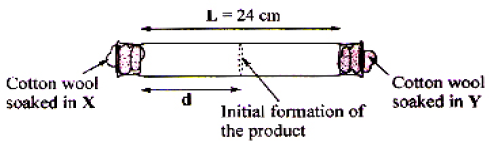
The experimental value of d is found to be smaller than the estimate obtained using Graham’s law. This is due to
(2014)
- larger means free path for X as compared to that of Y.
- larger means free path for Y as compared to that of X.
- increased collision frequency of Y with the inert gas as compared to that of X with the inert gas.
- increased collision frequency of X with the inert gas as compared to that of Y with the inert gas.
Answer
(D) increased collision frequency of X with the inert gas as compared to that of Y with the inert gas.
Sign up free on Edukali to view the step-by-step worked solution and practice thousands of similar questions.
Related practice questions
- Which of the following volume (V)-temperature (T) plots represents the behaviour of one mole of an ideal gas…
- Which of the following statement(s) is (are) correct regarding the root mean square speed (U rms ) and…
- A given quantity of an ideal gas is at pressure P and absolute temperature T . The isothermal bulk modulus of…
- Equal weights of ethane and hydrogen are mixed in an empty container at 25ºC. The fraction of the total…
- According to kinetic theory of gases, for a diatomic molecule (1991)
- For a monatomic gas kinetic energy = E. The relation with rms velocity is (2004)
- If the pressure is tripled and temperature (in kelvins) is halved, the volume of a given mass of an ideal gas…
- Consider the adjacent diagram to answer these questions : Initially, flask A contained oxygen gas at 27ºC and…
More States of Matter (Gases and Liquids) questions · Browse all practice questions