When a particle of mass m moves on the x -axis in a potential of the form V ( x ) = kx 2…
Physics · JEE Advanced · NTA Exams — Laws of Motion
When a particle of mass m moves on the x-axis in a potential of the form V(x) = kx2, it performs simple harmonic motion. The corresponding time period is proportional to  as can be seen easily using dimensional analysis. However, the motion of a particle can be periodic even when its potential energy increases on both sides of x = 0 in a way different from kx2 and its total energy is such that the particle does not escape to infinity.
Consider a particle of mass m moving on the x-axis. Its potential energy is V(x) = ax4 (a > 0) for |x| near the origin and becomes a constant equal to V0 for |x| ≥ X0 (see figure).
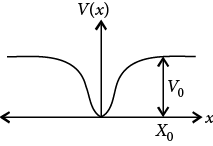
The acceleration of this particle for |x| > X0 is
as can be seen easily using dimensional analysis. However, the motion of a particle can be periodic even when its potential energy increases on both sides of x = 0 in a way different from kx2 and its total energy is such that the particle does not escape to infinity.Consider a particle of mass m moving on the x-axis. Its potential energy is V(x) = ax4 (a > 0) for |x| near the origin and becomes a constant equal to V0 for |x| ≥ X0 (see figure).
The acceleration of this particle for |x| > X0 is
- proportional to V0
- proportional to

- proportional to

- zero
Answer
(D) zero
Sign up free on Edukali to view the step-by-step worked solution and practice thousands of similar questions.
Related practice questions
- A pendulum consists of a wooden bob of mass m and of lenght l . A bullet of mass m 1 is fired towards the…
- What is the maximum value of the force F such that the block shown in the arrangement, does not move?
- Block A and B are resting on a smooth horizontal surface given equal speeds of 2 m/s in opposite sense as…
- A trolley car slides down a smooth inclined plane of angle of inclination . If a body is suspended from the…
- A pendulum bob of mass m connected to the end of an ideal string of length l is released from rest from…
- During paddling of a bicycle, the force of friction exerted by the ground on the two wheels is such that it…
- The engine of a car produces acceleration of 4 m s^ -2 in car. If this car pulls another car of same mass…
- Assertion: The acceleration of a particle as seen from an inertial frame is zero if no external force acts on…
More Laws of Motion questions · Browse all practice questions