A block ( B ) is attached to two unstretched springs S 1 and S 2 with spring constants k…
Physics · JEE Advanced · NTA Exams — Oscillations and Waves
A block (B) is attached to two unstretched springs S1 and S2 with spring constants k and 4k, respectively (see figure I). The other ends are attached to identical supports M1 and M2 not attached to the walls.
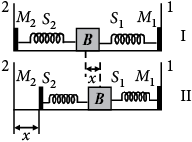
The springs and supports have negligible mass. There is no friction anywhere. The block B is displaced towards wall 1 by a small distance x (figure II) and released. The block returns and moves a maximum distance y towards wall 2 . Displacements x and y are measured with respect to the equilibrium position of the block B. The ratio y/x is
The springs and supports have negligible mass. There is no friction anywhere. The block B is displaced towards wall 1 by a small distance x (figure II) and released. The block returns and moves a maximum distance y towards wall 2 . Displacements x and y are measured with respect to the equilibrium position of the block B. The ratio y/x is
- 4
- 2
- 1/2
- 1/4
Answer
(C) 1/2
Sign up free on Edukali to view the step-by-step worked solution and practice thousands of similar questions.
Related practice questions
- An object of specific gravity r is hung from a thin steel wire. The fundamental frequency for transverse…
- Two bodies M and N of equal masses are suspended from two separate massless springs of force constants k_ 1…
- Two stretched strings of same material are vibrating under the same tension in fundamental mode. The ratio of…
- A car sounding its horn at 480 Hz moves towards a high wall at a speed of 20 m/s. If the speed of sound is…
- Two sound waves of the same frequency have respective amplitudes of 3 units and 1 unit and are travelling in…
- A spring has a natural length of 50 cm and a force constant of 2.0 × 10³ Nm–1. A body of mass 10 kg is…
- The equation of motion of a particle executing simple harmonic motion is a+16 p^ 2 x=0 . In this equation, a…
- A body of mass 0.01 kg executes simple harmonic motion (S.H.M.) about x = 0 under the influence of a force…
More Oscillations and Waves questions · Browse all practice questions