If α and β are the roots of the quadratic equation, x 2 + x sinθ – 2 sinθ = 0, then is…
Mathematics · JEE Main · NTA Exams — Complex Numbers and Quadratic Equations
If α and β are the roots of the quadratic equation, x2 + x sinθ – 2 sinθ = 0, then
is equal to
- \(\frac{2^{12}}{(\sin \theta+8)^{12}}\)
- \(\frac{2^{6}}{(\sin \theta+8)^{12}}\)
- \(\frac{2^{12}}{(\sin \theta-4)^{12}}\)
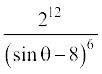
Answer
(A) 2^ 12 ( +8)^ 12
Sign up free on Edukali to view the step-by-step worked solution and practice thousands of similar questions.
Related practice questions
- If the roots of the equations x 2 + 3x + 2 = 0 & x 2 – x + λ = 0 are in the same ratio of 4 9 then the value…
- The sum of all real roots of the equation |x – 2| 2 + |x – 2| – 2 = 0, is
- If x = a + b, y = aα + bβ, z = aβ + bα, where α, β are complex cube roots of unity, (a, b ∈ R ), then xyz…
- If ω is a non-real cube root of unity, then the expression (1–ω) (1–ω 2 ) (1+ω 4 ) (1+ω 8 ) is equal to
- The value of is equal to
- If 1, II 1 , .......... II n - 1 are the n th roots of unity and n is an odd natural number then (1 + II 1…
- If the cube roots of unity are 1, ω, ω 2 , then the roots of the equation (x – 1) 3 + 8 = 0, are:
- If is non real cube root of unity then, the value of (1+ - ^ 2 )^ 2 + (1- + ^ 2 )^ 2 is equal to :
More Complex Numbers and Quadratic Equations questions · Browse all practice questions