A system goes from A to B via two process I and II as shown in figure. If U_ 1 and U_ 2…
Physics · JEE Main · NTA Exams — Kinetic Theory of Gases
A system goes from A to B via two process I and II as shown in figure. If \(\Delta U_{1}\) and \(\Delta U_{2}\) are the changes in internal energies in the processes I and II respectively, then
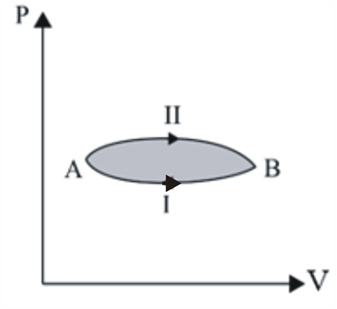
- \(\Delta U_{2}>\Delta U_{1}\)
- \(\Delta U_{2}<\Delta U_{1}\)
- \(\Delta U_{1}=\Delta U_{2}\)
- relation between \(\Delta U_{1}\) and \(\Delta U_{2}\) cannot be determined
Answer
(C) U_ 1 = U_ 2
Sign up free on Edukali to view the step-by-step worked solution and practice thousands of similar questions.
Related practice questions
- A refrigerator works between 4^ C and 30^ C . It is required to remove 600cal of heat every second in order…
- Two cylinders A and B fitted with pistons contain equal amounts of an ideal diatomic gas at 300 K. The piston…
- The increase in internal energy of a gas per unit mass per unit rise in temperature is equal to ( C_ v and C_…
- A refrigerator is to maintain eatables kept inside at 9^ C , calculate the coefficient of performance? (Room…
- The coefficient of performance for a refrigerator should be:
- If the pressure of the gas is doubled at constant volume and mass, the frequency of collision of the…
- Three perfect gases at absolute temperature T 1 , T 2 and T 3 are mixed. The masses of molecules are m 1 , m…
- Even Carnot engine cannot give 100% efficiency because we cannot
More Kinetic Theory of Gases questions · Browse all practice questions