Consider the following reaction that goes from A to B in three steps as shown below…
Chemistry · JEE Main · NTA Exams — Chemical Kinetics
Consider the following reaction that goes from A to B in three steps as shown below:
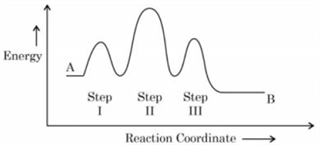
Choose the correct option (Jee Main 2023)
Choose the correct option (Jee Main 2023)
| Number of intermediates | Number of Activated complexes | Rate determining step | |
| A | 2 | 3 | II |
| B | 2 | 3 | I |
| C | 2 | 2 | II |
| D | 2 | 3 | III |
- A
- B
- C
- D
Answer
(A) A
Sign up free on Edukali to view the step-by-step worked solution and practice thousands of similar questions.
Related practice questions
- The following data were obtained during the first order thermal decomposition of SO 2 Cl 2 at a constant…
- Given below are two statements. One is labelled as Assertion and the other is labelled as Reason…
- Rate of a reaction can be expressed by Arrhenius equation as k = A e –E/RT In this equation, E represents
- The rate constant of a reaction is given by lnk (sec –1 ) = 14.34 – (1.25 × 10 4 )/T What will be the energy…
- The following results were obtained during kinetic studies of the reaction: 2A + B → Products Experiment [A]…
- In a reaction A → B threshold energy of the reactant is 120 kJ mole –1 and the normal energy of the reactant…
- Which of the following represents the expression for 3/4th life of a first order reaction
- The rate of reaction A + B + C → Products is given by Rate = k [A] 1/2 [B] 1/3 [C] The order of the reaction…
More Chemical Kinetics questions · Browse all practice questions