An organic compound C 6 H 12 ( X ) on reduction gives C 6 H 14 ( Y ). X on ozonolysis…
Chemistry · Class 11 · CBSE — Hydrocarbons
An organic compound C6H12 (X) on reduction gives C6H14 (Y). X on ozonolysis gives two aldehydes C2H4O (I) and C4H8O (II). Identify the compounds X, Y and aldehydes (I) and (II).
- X = CH3CH CHCH2CH2CH3, Y = CH3(CH2)4CH3, (I) = CH3CHO, (II) = CH3(CH2)2CHO
- X = CH3CH2CH CHCH2CH3, Y = CH3(CH2)4CH3, (I) = CH3CHO, (II) = CH3CHO
- X = CH3CH2CH2CH2CH CH2, Y = CH3(CH2)3CH3, (I) = HCHO, (II) = CH3(CH2)2CHO
- X =
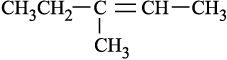 , Y = CH3(CH2)3CH3, (I) = CH3CHO, (II) = CH3CH2CHO
Answer
(A) X = CH 3 CH CHCH 2 CH 2 CH 3 , Y = CH 3 (CH 2 ) 4 CH 3 , (I) = CH 3 CHO, (II) = CH 3 (CH 2 ) 2 CHO
Sign up free on Edukali to view the step-by-step worked solution and practice thousands of similar questions.
Related practice questions
- Which of the following reactions does not show the acidic nature of ethyne?
- What is the order of reactivity of hydrogen atoms attached to carbon atom in an alkene?
- Fill in the blanks with appropriate words. Benzene has a planar structure. All carbon atoms in benzene are…
- In the following question, a statement of assertion is followed by a statement of reason. Mark the correct…
- Which of the following alcohols on dehydration gives most stable carbocation?
- A mixture of 1-iodoethane and 1-iodopropane is treated with sodium metal and dry ether to carry out Wurtz…
- During halogenation of alkanes the halogens and alkane show a specific trend. Which of the following…
- In the following question, a statement of assertion is followed by a statement of reason. Mark the correct…