A particle of mass m and charge q moving with velocity V enters region II normal to the…
Physics · JEE Advanced · NTA Exams — Magnetic Effects of Current and Magnetism
A particle of mass m and charge q moving with velocity V
enters region II normal to the boundary as shown in the figure. Region II has a uniform magnetic field B perpendicular to the plane of the paper. The length of the region II is l. Choose the correct choice(s).
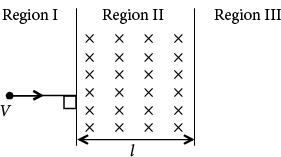
enters region II normal to the boundary as shown in the figure. Region II has a uniform magnetic field B perpendicular to the plane of the paper. The length of the region II is l. Choose the correct choice(s).
- The particle enters region III only if its velocity

- The particle enters region III only if its velocity

- Path length of the particle in region II is maximum when velocity

- Time spent in region II is same for any velocity V as long as the particle returns to region I.
Answer
(A) The particle enters region III only if its velocity
Sign up free on Edukali to view the step-by-step worked solution and practice thousands of similar questions.
Related practice questions
- An electron is moving along positive x-axis. You want to apply a magnetic field for a short time so that…
- A charged particle q enters a region of uniform magnetic field B (directed out of page as shown) and is…
- Figure shows the cross-sectional view of the hollow cylindrical conductor with inner radius ‘R’ and outer…
- Statement-1 : A proton moving vertically upwards enters a magnetic field directed towards South. It will be…
- A particle of charge per unit mass α is released from origin with a velocity of v = v _ 0 i in uniform…
- Statement-1 : The magnetic field at the ends of a very long solenoid carrying current is half of that at the…
- A proton accelerated by a potential difference 500 KV moves though a transverse magnetic field of 0.51 T as…
- Two ions having masses in the ratio 1 : 1 and charges 1 : 2 are projected into uniform magnetic field…
More Magnetic Effects of Current and Magnetism questions · Browse all practice questions