A parallel beam of monochromatic light is used in a Young’s double slit experiment. The…
Physics · JEE Advanced · NTA Exams — Optics
A parallel beam of monochromatic light is used in a Young’s double slit experiment. The slits are separated by a distance d and the screen is placed parallel to the plane of the slits. The angle which the incident beam must make with the normal to the plane of the slits to produce darkness at the position of central brightness is
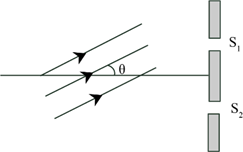
- \(\cos ^{-1} \frac{\lambda}{d}\)
- \(\cos ^{-1} \frac{2 \lambda}{d}\)
- \(\sin ^{-1} \frac{\lambda}{d}\)
- \(\sin ^{-1} \frac{\lambda}{2 d}\)
Answer
(D) ^ -1 2 d
Sign up free on Edukali to view the step-by-step worked solution and practice thousands of similar questions.
Related practice questions
- A thin rod of length f/3 lies along the axis of a concave mirror of focal length f. One end of its magnified…
- Statement-1 : The images formed by total internal reflections are much brighter than those formed by mirrors…
- What will be the focal length if its curved surface is mirrored?
- The image of point P when viewed from top of the slabs will be
- Assertion: If a glass slab is placed in front of one of the slits, then fringe width will decrease. Reason…
- Statement-1 : A convex lens of focal length f (µ = 1.5) behaves as a diverging lens when immersed in carbon…
- Statement–1 : When a concave mirror is held under water, its focal length will increase. Statement–2 : The…
- If the ratio of amplitude of two waves is 4 : 3, then the ratio of maximum and minimum intensity is