Let α( a ) and β( a ) be the roots of the equation where a > –1 . Then _ a 0^ + (a) ext…
Mathematics · JEE Advanced · NTA Exams — Complex Numbers and Quadratic Equations
Let α(a) and β(a) be the roots of the equation  where
where
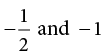
a > –1 . Then \(\lim _{a \rightarrow 0^{+}} \alpha(a) \ ext { and } \lim _{a \rightarrow 0^{+}} \beta(a)\) are
where a > –1 . Then \(\lim _{a \rightarrow 0^{+}} \alpha(a) \ ext { and } \lim _{a \rightarrow 0^{+}} \beta(a)\) are



Answer
(B)
Sign up free on Edukali to view the step-by-step worked solution and practice thousands of similar questions.
Related practice questions
- If a , b , c , d are positive real numbers such that a + b + c + d = 2, then M = ( a + b ) ( c + d )…
- The value of k for which the equation x 3 – 3x + k = 0 has The correct matching is :
- In the given figure vertices of ∆ ABC lie on y = f (x) = ax 2 + bx + c. The ∆ ABC is right angled isosceles…
- Match the equation on the left with the curve they represent on the right The correct matching is
- If roots of the equation x 4 – 12x 3 + bx 2 + cx + 81 = 0 are positive then
- If | z_ 1 z-z_ 2 z_ 1 z+z_ 2 |=K, K > 0 (z 1 , z 2 ≠ 0), then
- If 1, x 1 , x 2 , x 3 are the roots of x 4 - 1 = 0 and ω is an imaginary cube root of unity, then the value…
- Let =- 1 2 +i 3 2 . Then the value of | array ccc 1 & 1 & 1 1 & -1- ^ 2 & ^ 2 1 & ^ 2 & ^ 4 array |
More Complex Numbers and Quadratic Equations questions · Browse all practice questions