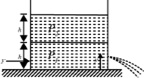
A cylindrical tank having cross sectional area A = 0.5 m 2 is filled with two liquids of…
Physics · JEE Advanced · NTA Exams — Properties of Solids and Liquids
A cylindrical tank having cross sectional area A = 0.5 m2 is filled with two liquids of density ρ1 = 900 kg m–3 and
ρ2 = 600 kg m–3, to a height h = 60 cm each as shown in the figure. A small whole having area a = 5 cm2 is made in right vertical wall at a height y = 20 cm from the bottom. A horizontal force F is applied on the tank to tank to keep it in static equilibrium. The tank is lying on a horizontal surface. Neglect mass of cylindrical tank in comparison to mass of liquids (take g = 10 ms–2).
A spherical solid ball of volume V is made of a material of density ρ1. It is falling through a liquid of density
ρ2. (ρ2 < ρ1). [Assume that the liquid applies a viscous force on the ball that is proportional to the square of its speed ν, ie, Fviscous = –kv2 (k > 0). The terminal speed of the ball is
- \(\sqrt{\frac{\mathrm{Q}\left(\rho_{1}-\rho_{2}\right)}{\mathrm{k}}}\)
- \(\frac{\mathrm{V} \rho_{1}}{\mathrm{k}}\)
- \(\sqrt{\frac{\mathrm{y} \rho_{1}}{\mathrm{k}}}\)
- \(\frac{\mathrm{V}\left(\rho_{1}-\rho_{2}\right)}{\mathrm{k}}\)
Answer
(A) Q ( _ 1 - _ 2 ) k
Sign up free on Edukali to view the step-by-step worked solution and practice thousands of similar questions.
Related practice questions
- Two metallic sphere S 1 and S 2 are made of the same material and have got identical surface finish. The mass…
- Two rods of different materials having co-efficients of thermal expansion α 1 , α 2 and Young’s modulii Y 1 …
- Two spheres P and Q of equal radii have densities r 1 and r 2 , respectively. The spheres are connected by a…
- If the container filled with liquid gets accelerated horizontally or vertically, pressure in liquids gets…
- A body floats in a liquid contained in a beaker. The whole system as shown in figure falls freely under…
- According to Hooke’s law, within the elastic limit stress/strain = constant. This constant depends on the…
- The adjacent graph shows the extension ( D l ) of a wire of length 1 m suspended from the top of a roof at…
- Three rods made of same material and having the same cross-section have been joined as shown in the figure…
More Properties of Solids and Liquids questions · Browse all practice questions