On the basis of relative position of different floral parts on the thalamus, a flower can…
Biology · Class 11 · CBSE — Morphology of Flowering Plants
On the basis of relative position of different floral parts on the thalamus, a flower can be hypogynous, perigynous or epigynous. With respect to the given figures (A, B, C and D), select the correct option.
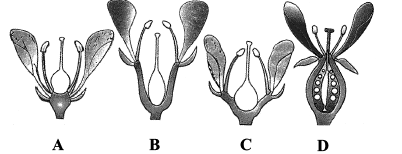
a
b
c
d
Answer
(A) a
Sign up free on Edukali to view the step-by-step worked solution and practice thousands of similar questions.
Related practice questions
- Add the missing floral organs in the given floral formula of family Fabaceae.
- Which plant part is modified into pitcher in pitcher plants?
- Ovary is said to be half inferior in which of the following conditions?
- Which of the following figures represent a typical placentation as seen in Hibiscus rosa sinensis (China…
- Spines present on the areoles of Opuntia represent
- Which floral family has (9) + 1 arrangement of anthers in the androecium?
- In ––––– placentation, a monocarpellary ovary bears a single longitudinal ovule along the junction of two…
- Which of the following represents the functions of veins in the leaves?
More Morphology of Flowering Plants questions · Browse all practice questions