We know how by neglecting the air resistance, the problems of projectile motion can be…
Physics · JEE Advanced · NTA Exams — Kinematics
We know how by neglecting the air resistance, the problems of projectile motion can be easily solved and analysed. Now we consider the case of the collision of a ball with a wall. In this case the problem of collision can be simplified by considering the case of elastic collision only. When a ball collides with a wall, we can divide its velocity into two components, one perpendicular to the wall and other parallel to the wall. If the collision is elastic, then the perpendicular component of velocity of the ball gets reversed with the same magnitude.
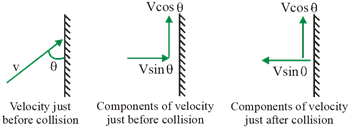
The other parallel component of velocity will remain constant if wall is given smooth.
Now let us take a problem. Three balls ‘A’ and ‘B’ & ‘C’ are projected from ground with same speed at same angle with the horizontal. The balls A, B and C collide with the wall during their flight in air and all three collide perpendicularly with the wall as shown in figure.
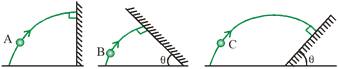
If the time taken by the ball A to fall back on ground is 4 seconds and that by ball B is 2 seconds. Then the time taken by the ball C to reach the inclined plane after projection will be:
- 6 sec
- 4 sec
- 3 sec
- 5 sec
Answer
(C) 3 sec
Sign up free on Edukali to view the step-by-step worked solution and practice thousands of similar questions.
Related practice questions
- Assertion: Two particles of different mass, projected with same velocity and angle of projection, the maximum…
- A small block is shot into each of the four tracks as shown below. Each of the tracks rises to the same…
- Assertion: Two stones are simultaneously projected from level ground from same point with same speeds but…
- A stone tied to a string of length L is whirled in a vertical circle with the other end of the string at the…
- A small block of mass M moves on a frictionless surface of an inclined plane, as shown in the figure. The…
- A car is moving on a straight road. The velocity of the car varies with time as shown in the figure…
- A particle is moving eastwards with a velocity of 5 m/s. In 10 s the velocity changes to 5 m/s northwards…
- Two trains are each 50 m long starts moving parallel towards each other at speeds 10 m/s and 15 m/s…