Assertion : The stress–strain graphs are shown in the figure for two materials A and B…
Physics · JEE Advanced · NTA Exams — Properties of Solids and Liquids
Assertion : The stress–strain graphs are shown in the figure for two materials A and B are shown in figure. Young’s modulus of A is greater than that of B.
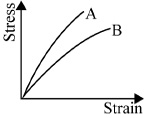
Reason : The Young’s modulus for small strain is, \(\mathrm{Y}=\frac{\text { stress }}{\text { strain }}=\) slope of linear portion, of graph; and slope of A is more than that of B.
Reason : The Young’s modulus for small strain is, \(\mathrm{Y}=\frac{\text { stress }}{\text { strain }}=\) slope of linear portion, of graph; and slope of A is more than that of B.
- If both Assertion and reason are true and reason is the correct explanation of the assertion.
- If both assertion and reason are true but reason is not the correct explanation of the assertion.
- If assertion is true but reason is false.
- If both assertion and reason are false.
Answer
(A) If both Assertion and reason are true and reason is the correct explanation of the assertion.
Sign up free on Edukali to view the step-by-step worked solution and practice thousands of similar questions.
Related practice questions
- A hemispherical portion of radius R is removed from the bottom of a cylinder of radius R . The volume of the…
- The velocity of the liquid coming out of a small hole of a vessel containing two different liquids of…
- A highly rigid cubical block A of small mass M and side L is fixed rigidly onto another cubical block B of…
- Two identical rods are connected between two containers. One of them is at 100°C containing water and another…
- A 5 kg rod of square cross section 5 cm on a side and 1 m long is pulled along a smooth horizontal surface by…
- The following four wires are made of the same material. Which of these will have the largest extension when…
- Two wires A and B have the same cross-section and are made of the same material, but the length of wire A is…
- A uniform rod of mass m, length L, area of cross-section A is rotated about an axis passing through one of…
More Properties of Solids and Liquids questions · Browse all practice questions