A spherically symmetric gravitational system of particles has a mass density = array c _…
Physics · JEE Advanced · NTA Exams — Gravitation
A spherically symmetric gravitational system of particles has a mass density \(\rho=\left\{\begin{array}{c}
\rho_{0} \text { for } r \leq R \\
0 \text { for } r>R
\end{array}\right.\) where ρ0 is a constant. A test mass can undergo circular motion under the influence of the gravitational field of particles. Its speed V as a function of distance r(0 < r < ∞) from the centre of the system is represented by
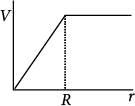
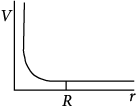
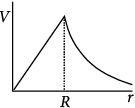
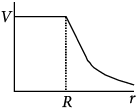
Answer
(C)
Sign up free on Edukali to view the step-by-step worked solution and practice thousands of similar questions.
Related practice questions
- The satellites when launched from earth are not given the orbital velocity initially, in practice, a…
- Two bodies, each of mass M , are kept fixed with a separation 2 L . A particle of mass m is projected from…
- A particle of mass m is placed inside a spherical shell, away from its centre. The mass of the shell is M.
- In the graph shown, the PE of earth-satellite system is shown by solid line as a function of distance r (the…
- The depth d at which the value of acceleration due to gravity becomes 1 n times the value at the surface, is…
- Assertion: We cannot move even a finger without disturbing all the stars. Reason: Everybody in this universe…
- Statement-1: A spherically symmetric shell produces no gravitational field anywhere. Statement-2: The field…
- An artificial satellite moving in a circular orbit around the earth has total (kinetic + potential) energy E…