Let z 1 = a 1 + ib 1 (a 1 , b 1 ) and z 2 = a 2 + ib 2 (a 2 , b 2 ); where i = -1 , be…
Mathematics · JEE Advanced · NTA Exams — Complex Numbers and Quadratic Equations
Let z1 = a1 + ib1 \(\equiv\)(a1, b1) and z2 = a2 + ib2 \(\equiv\) (a2, b2); where \(\mathrm{i}=\sqrt{-1},\) be two complex numbers.
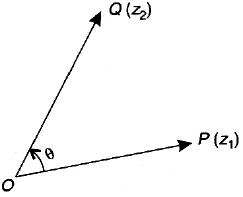
If ∠POQ = θ, From Rotation theorem
\(\frac{z_{2}-0}{z_{1}-0}=\frac{\left|z_{2}\right|}{\left|z_{1}\right|} e^{i \theta} \Rightarrow \frac{z_{2} \bar{z}_{1}}{z_{1} \bar{z}}=\frac{\left|z_{2}\right|}{\left|z_{1}\right|} e^{i \theta}\)
⇒ \(\frac{\mathrm{z}_{2} \overline{\mathrm{z}}_{1}}{\left|\mathrm{z}_{1}\right|^{2}}=\frac{\left|\mathrm{z}_{2}\right|}{\left|\mathrm{z}_{1}\right|} \mathrm{e}^{\mathrm{i} \theta} \Rightarrow \mathrm{z}_{2} \overline{\mathrm{z}}_{1}=\left|\mathrm{z}_{1}\right|\left|\mathrm{z}_{2}\right| \mathrm{e}^{\mathrm{i} \theta}\)
⇒ \(z_{2} \bar{z}_{1}=\left|z_{1}\right|\left|z_{2}\right|(\cos \theta+i \sin \theta)\)
∴ \(\operatorname{Re}\left(\mathrm{z}_{2} \overline{\mathrm{z}}_{1}\right)=\left|\mathrm{z}_{1}\right|\left|\mathrm{z}_{2}\right| \cos \theta\) ... (i)
and \(\operatorname{Im}\left(\mathrm{z}_{2} \overline{\mathrm{z}}_{1}\right)=\left|\mathrm{z}_{1}\right|\left|\mathrm{z}_{2}\right| \sin \theta\) ... (ii)
The dot product of z1 and z2 is defined by z1 . z2 = |z1| |z2|
cos θ = Re \(\left(\mathrm{z}_{2} \overline{\mathrm{z}}_{1}\right)\)[from (i)] and cross product of z1 and z2 is defined z1 × z2 = |z1| |z2| sin θ = Im \(\left(\mathrm{z}_{2} \overline{\mathrm{z}}_{1}\right)\) [from Eq. (ii)]
If z1 = 2 + 5i, z2 = 3 – i, then the value of
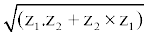 is equal to
- 2
- 3
- \(2 \sqrt{3}\)
- \(3 \sqrt{2}\)
Answer
(D) 3 2
Sign up free on Edukali to view the step-by-step worked solution and practice thousands of similar questions.
Related practice questions
- If α, β are the roots of x 2 – p (x + 1) – c = 0 then ^ 2 +2 +1 ^ 2 +2 +c + ^ 2 +2 +1 ^ 2 +2 +c is equal to
- If |z- 4 z |=2, then the maximum value of | z | is equal to
- If | z_ 1 z-z_ 2 z_ 1 z+z_ 2 |=K, K > 0 (z 1 , z 2 ≠ 0), then
- Let P denotes a complex number z on the Argand’s plane, and Q denotes a complex number 2|z|^ 2 CiS ( 4 + )…
- If a, b ∈ R, a b . The roots of the quadratic equation, x 2 – 2 (a + b) x + 2 (a 2 + b 2 ) = 0 are
- If the complex numbers z 1 , z 2 , z 3 satisfying z_ 1 -z_ 3 z_ 2 -z_ 3 = 1-i 3 2 then triangle is
- For a > 0, the roots of the equation l og ax a + l og x a 2 + l og a 2 x a 3 = 0, are given by
- If roots of the equation x 4 – 12x 3 + bx 2 + cx + 81 = 0 are positive then
More Complex Numbers and Quadratic Equations questions · Browse all practice questions