Consider the function f : (– ∞, ∞) → (– ∞, ∞) defined by Let g(x)= _ 0 ^ e^ x f^ (t) 1+t^…
Mathematics · JEE Advanced · NTA Exams — Limit, Continuity and Differentiability
Consider the function f : (– ∞, ∞) → (– ∞, ∞) defined by 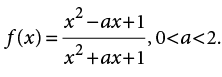
Let \[g(x)=\int_{0}^{e^{x}} \frac{f^{\prime}(t)}{1+t^{2}} d t\] Which of the following is true?
Let \[g(x)=\int_{0}^{e^{x}} \frac{f^{\prime}(t)}{1+t^{2}} d t\] Which of the following is true?
- g′(x) is positive on (– ∞, 0) and negative on (0, ∞)
- g′(x) is negative on (– ∞, 0) and positive on (0, ∞)
- g′(x) changes sign on both (– ∞, 0) and (0, ∞)
- g′(x) does not change sign on (– ∞, ∞).
Answer
(B) g ′ ( x ) is negative on (– ∞ , 0) and positive on (0, ∞ )
Sign up free on Edukali to view the step-by-step worked solution and practice thousands of similar questions.
Related practice questions
- Let f(x)= array cl x^ 2 | x |, & x 0 0, & x=0 array , x R, . then f is
- The function f ( x ) = max (1 – x ), (1 + x ), 2 , x ∈(–∞ , ∞), is
- Consider two functions f (x) = _ n ( x n )^ n and g(x) = –x 4b where b = _ x ( x^ 2 +x+1 - x^ 2 +1 ) Then. f…
- Let [⋅] denote the greatest integer function and f ( x ) = [tan 2 x ], then
- Let f(x)= array c |x| ; for 0<|x| 2 1 ; for x=0 array , then at x=0, f . has
- If x is a real number in [0, 1] then the value of _ m _ n [1 + cos 2m (n!πx)] is given by, where [x]…
- Let f(x)= 1-x(1+|1-x|) |1-x| ( 1 1-x ) for x 1 . Then
- Let f be a real-valued function defined on the interval (0, ∞) by f(x)= x+ _ 0 ^ x 1+ t d t Then which of the…
More Limit, Continuity and Differentiability questions · Browse all practice questions