Secondary and tertiary alcohols always gives E 1 reaction in dehydration. Primary…
Chemistry · JEE Advanced · NTA Exams — Alcohols, Phenols and Ethers
Secondary and tertiary alcohols always gives E1
reaction in dehydration. Primary, alcohols whose β-carbon is 3oor 4o also give E1 reaction. However, the primary alcohols whose β-carbon is 1oor 2o give E2 reaction. Dehydrating agents like conc. H2SO4, Al2O3, anhydrous ZnCl2 are used.
The reactivity of alcohols for elimination reaction lies in following sequence:
Tertiary alcohol > secondary alcohol > primary alcohol
Electron attracting groups present in alcohols decrease the reactivity for dehydration. Greater is the –I effect of the group present in alcohol, less will be its reactivity. Both E1 and E2 mechanism give the product according to Saytzeff’s rule, i.e., major product is the most substituted alkene
\[\text { 3-Methyl butan-2-ol }\]
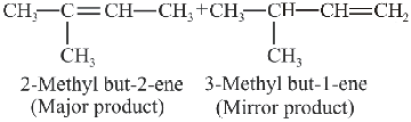
Answer the following questions:
Which among the following alcohols will be the most reactive for dehydration?
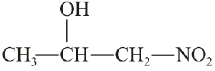
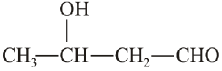
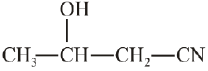
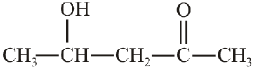
Answer
(D)
Sign up free on Edukali to view the step-by-step worked solution and practice thousands of similar questions.
Related practice questions
- The compound that does not liberate CO 2 , on treatment with aqueous sodium bicarbonate solution, is
- In the reaction the products are
- (I) 1,2-dihydroxybenzene (II) 1,3-dihydroxybenzene (III) 1,4-dihydroxybenzene (IV) Hydroxybenzene. The…
- 1-propanol and 2-propanol can be best distinguished by (2001)
- By a proper choice of reagents, both symmetrical and unsymmetrical ethers can be prepared by Williamson…
- Phenol reacts with bromine in carbon disulphide at low temperature to give
- Phenol on standing in air develops a red colour due to formation of:
- The order of reactivity of the following alcohols towards conc. HCl is: (I) (II) (III) (IV)
More Alcohols, Phenols and Ethers questions · Browse all practice questions