A particle is moved from (0, 0) to (a, a) under a force F =( 3 i +4 j ) from two paths…
Physics · JEE Main · NTA Exams — Work, Energy and Power
A particle is moved from (0, 0) to (a, a) under a force \(\vec{F}=(\hat{3 i}+4 \hat{j})\) from two paths. Path 1 is OP and path 2 is OQP. Let W1 and W2 be the work done by this force in these two paths. Then:
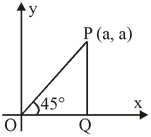
- W1 = W2
- W1 = 2W2
- W2 = 2W1
- W2 = 4W1
Answer
(A) W 1 = W 2
Sign up free on Edukali to view the step-by-step worked solution and practice thousands of similar questions.
Related practice questions
- A horizonal force F pulls a 10 kg carton across the floor at a constant speed. If the coefficient of sliding…
- The work done by a particle moving with a velocity of 0.7 c (where c is the velocity of light) in empty space…
- A block is moved from rest through a distance of 4 m along a straight-line path. The mass of the block is 5…
- A body is falling with velocity 1 m/s at a height 3 m from the ground. The speed at height 2 m from the…
- An object moving horizontally with kinetic energy of 800 J experiences a constant opposing force of 100 N…
- A spring of spring constant 1000 N/m is compressed through 5 cm and is used to push a metal ball of mass 0.1…
- Given below are two statements. One is labelled as Assertion and the other is labelled as Reason. Assertion…
- A box is dragged across a floor by a rope which makes an angle of 45° with the horizontal. The tension in the…
More Work, Energy and Power questions · Browse all practice questions