The variation of decay rate of two radioactive samples A and B with time is shown in…
Physics · Class 12 · CBSE — Nuclei
The variation of decay rate of two radioactive samples A and B with time is shown in figure.
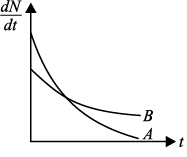
Which of the following statements is/are true?
- Decay constant of A is greater than that of B, hence A always decays faster than B.
- Decay constant of A is greater than that of B, but it does not always decays faster than B.
- Decay constant of B is smaller than that of A but still its decay rate becomes equal to that
of A at a later instant. Both (b) and (c).
Answer
(D) Both (b) and (c).
Sign up free on Edukali to view the step-by-step worked solution and practice thousands of similar questions.
Related practice questions
- At a given instant, there are 25% undecayed radioactive nuclei in a sample. After 10 seconds the number of…
- If the nucleus _ 13 ^ 27 Al has a nuclear radius of about 3.6 fm, then _ 32 ^ 125 Te would have its radius…
- The mass number of a nucleus is always less than its atomic number always more than its atomic number…
- Fission of nuclei is possible because the binding energy per nucleon in them
- A radioactive decay can form an isotope of the original nucleus with the emission of particles
- The ratio of the nuclear densities of two nuclei having mass numbers 64 and 125 is
- How much mass has to be converted into energy to produce electric power of 500 MW for one hour?
- Assertion (A): Unlike electric forces and gravitational forces, nuclear force has limited range. Reason (R)…