Extended tier only In an experiment to determine the nature of liquids, some very tiny…
Physics · IGCSE · Cambridge (CIE) — Thermal physics
Extended tier only
In an experiment to determine the nature of liquids, some very tiny pollen grains are suspended in water. They are illuminated by a bright light, and observed under a microscope.
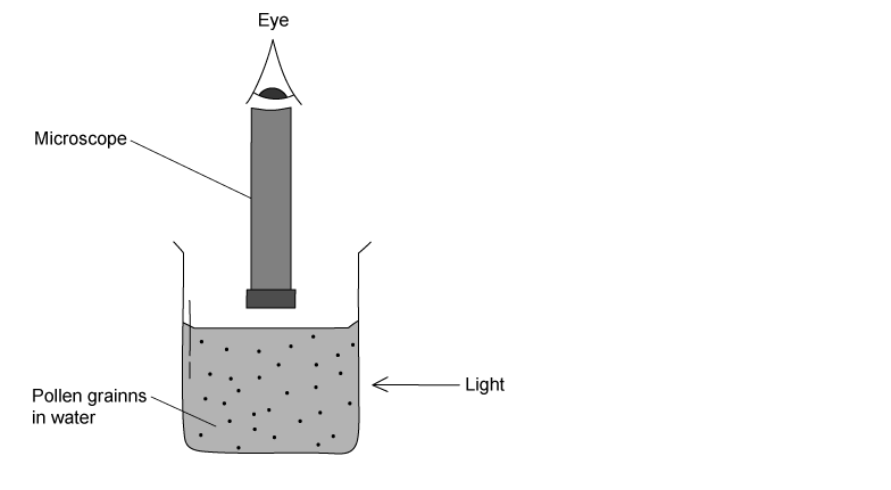
The view through the microscope is of small, bright dots, which move about at random, rapidly and they frequently change direction.
Which of the following would be the correct explanation for the observation through the microscope?
The bright dots are water molecules, being hit by other water molecules.
The bright dots are water molecules, which are vibrating due to their thermal kinetic energy.
The bright dots are pollen grains, which are being hit many times per second by water molecules.
The bright dots are pollen grains, which are vibrating due to their thermal kinetic energy.
Answer
(C) The bright dots are pollen grains, which are being hit many times per second by water molecules.
Sign up free on Edukali to view the step-by-step worked solution and practice thousands of similar questions.
Related practice questions
- A sealed piston is used to expand a gas. No gas escapes during the process. What happens to both the density…
- When using a microscope to look at smoke particles in air, Brownian motion is observed. What causes the smoke…
- Some properties of a substance are listed. The particles vibrate about fixed positions. It has no fixed…
- The list gives three properties of different states of matter. They cannot be compressed significantly. They…
- A balloon is filled with air and tied closed. The balloon is placed in a refrigerator. What happens to the…
- Descriptions of two different states of matter are shown below. To which state of matter do each of the…
- A sealed rigid container has a fixed volume. The container is filled with air. The container is placed in a…
- Gases, liquids and solids are made up of small particles. Which row gives the relative separation of the…
More Thermal physics questions · Browse all practice questions