The figure below shows the variation of specific heat capacity ( C ) of a solid as a…
Chemistry · JEE Advanced · NTA Exams — Chemical Thermodynamics
The figure below shows the variation of specific heat capacity (C) of a solid as a function of temperature (T). The temperature is increased continuously from
0 to 500 K at a constant rate. Ignoring any volume change, the following statement(s) is (are) correct to a reasonable approximation.
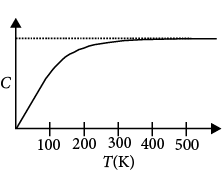
0 to 500 K at a constant rate. Ignoring any volume change, the following statement(s) is (are) correct to a reasonable approximation.
- The rate at which heat is absorbed in the range
0-100 K varies linearly with temperature T. - Heat absorbed in increasing the temperature from 0-100 K is less than the heat required for increasing the temperature from 400-500 K.
- There is no change in the rate of heat absorption in the range 400-500 K.
- The rate of heat absorption increases in the range 200-300 K.
Answer
(B) Heat absorbed in increasing the temperature from 0-100 K is less than the heat required for increasing the temperature from 400-500 K.
Sign up free on Edukali to view the step-by-step worked solution and practice thousands of similar questions.
Related practice questions
- The reversible expansion of an ideal gas under adiabatic and isothermal conditions is shown in the figure…
- Heat of neutralization of a strong dibasic acid in dilute solution by NaOH is nearly
- The standard state Gibbs free energies of formation of C (graphite) and C (diamond) at T = 298 K are Δ f G…
- In thermodynamics, the P − V work done is given by w=- d V P_ e x t For a system undergoing a particular…
- The lattice energy of solid NaCl is 180 kcal per mol. The dissolution of the solid in water in the form of…
- In thermodynamics the P-V work done is given by w =- dVP _ ext For a system undergoing a particular process…
- The enthalpy of combustion for octane (a major component of gasoline) is – 47.8 kJ/g. How much energy is…
- A gas is enclosed in a cylinder with a movable frictionless piston. Its initial thermodynamic state at…
More Chemical Thermodynamics questions · Browse all practice questions