The first, second and middle term of an AP are a, b, c respectively. Sum of all terms is
Mathematics · JEE Main · NTA Exams — Progression and Series
The first, second and middle term of an AP are a, b, c respectively. Sum of all terms is
- \(\frac{2(\mathrm{c}-\mathrm{a})}{\mathrm{b}-\mathrm{a}}\)
- \(\frac{2 \mathrm{c}(\mathrm{c}-\mathrm{a})}{\mathrm{b}-\mathrm{a}}+\mathrm{c}\)
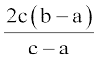
- \(\frac{2 b(c-a)}{b-a}\)
Answer
(B) 2 c ( c - a ) b - a + c
Sign up free on Edukali to view the step-by-step worked solution and practice thousands of similar questions.
Related practice questions
- If the arithmetic Mean of two positive numbers a and b (a > b) is twice their geometric Mean, then a : b is
- Three non-zero real numbers form an AP and the squares of these numbers taken in the same order form a GP…
- Let S_ k = _ r=1 ^ k ^ -1 ( 6^ r 2^ 2 r+1 +3^ 2 r+1 ) Then _ k S_ k is equal to
- If 5_ 1 , 5_ 2 , 5_ 3 5_ n are the sum of infinite geometric series whose first terms are 1, 2, 3,......n and…
- If a_ k a_ k-1 +a_ k-1 a_ k-2 =2 a_ k a_ k-2 , k 3 and here S_ p = _ k=1 ^ p 1 a_ k and given that S_ 2 p S_…
- Sum of infinite terms of series 3+5 1 4 +7 1 4^ 2 + . is
- If a_ 1 b_ 1 c are three unequal positive quantities in HP, then :
- The largest term common to the sequences 1, 11, 21, 31, .... to 100 terms and 31, 36, 41, 46 ....to 100 terms…
More Progression and Series questions · Browse all practice questions