A body of mass m rests on horizontal surface. The coefficient of friction between the…
Physics · JEE Advanced · NTA Exams — Laws of Motion
A body of mass m rests on horizontal surface. The coefficient of friction between the body and the surface is m. If the mass is pulled by a force P as shown in the figure, the limiting friction between body and surface will be:
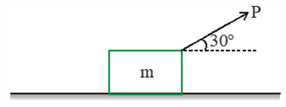
- \(\mu m g\)
- \(\mu\left[m g+\left(\frac{P}{2}\right)\right]\)
- \(\mu\left[m g-\left(\frac{P}{2}\right)\right]\)
- \(\mu\left[m g-\left(\frac{\sqrt{3} P}{2}\right)\right]\)
Answer
(C) [m g- ( P 2 ) ]
Sign up free on Edukali to view the step-by-step worked solution and practice thousands of similar questions.
Related practice questions
- You are supplied with three identical rods of same length and mass. The length of each rod is 2π. Two of them…
- A ball is suspended by a thread from the ceiling of a car. The brakes are applied and the speed of the car…
- A circular plate of uniform thickness has a diameter of 28 cm. A circular portion of diameter 21 cm is…
- Statement – 1: If no external force acts on a system of particles, then the centre of mass will not move in…
- A block of mass m is resting on a wedge of angle as shown in the figure. The wedge is given an acceleration…
- A block of mass 3 kg is at rest on a rough inclined plane as shown in the figure. The magnitude of net force…
- A body moving towards a body of finite mass at rest collides with it. It is possible that
- A uniform chain of length l is placed on a rough table with length l /n (n > 1) hanging over the edge. If the…
More Laws of Motion questions · Browse all practice questions