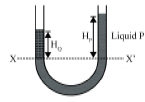
Two immiscible liquids P and Q of different densities are contained in a wide U-tube as…
Physics · JEE Advanced · NTA Exams — Properties of Solids and Liquids
Two immiscible liquids P and Q of different densities are contained in a wide U-tube as shown in fig. The heights of the two liquids above the horizontal line XX` which cuts the boundary between the liquids are HP and HQ respectively. The U-tube is transported to a planet where the acceleration of free fall is 2/3 that on the earth, where the liquids do not evaporate and where the heights of liquid (measured relative to XX`) are hP and hQ respectively. Which of the given statements is correct?
- The liquid levels are unchanged, i.e.,
hP = HP and hQ = HQ - Both liquid levels rise up so that hP/HP = hQ/HQ
- Both liquid levels rise up so that hP - hQ
= HP - HQ - The liquid P falls and liquid Q rises such that \(\frac{\mathrm{h}_{\mathrm{P}}}{\mathrm{~h}_{\mathrm{Q}}}=\frac{2}{3} \frac{\mathrm{H}_{\mathrm{P}}}{\mathrm{H}_{\mathrm{Q}}}\)
Answer
(A) The liquid levels are unchanged, i.e., h P = H P and h Q = H Q
Sign up free on Edukali to view the step-by-step worked solution and practice thousands of similar questions.
Related practice questions
- A heavy block of mass 150 kg hangs with the help of three vertical wires of equal length and equal cross…
- Two spheres P and Q of equal radii have densities r 1 and r 2 , respectively. The spheres are connected by a…
- According to Hooke’s law, within the elastic limit stress/strain = constant. This constant depends on the…
- When liquid medicine of density ρ is to be put in the eye, it is done with the help of a dropper. As the bulb…
- Steam at 100°C is passed into 1.1 kg of water contained in a calorimeter of water equivalent 0.02 kg at 15°C…
- A substance breaks down under a stress of 10 5 Pa. If the density of the wire is 2 × 10 3 kg/m 3 , find the…
- A 5 kg rod of square cross section 5 cm on a side and 1 m long is pulled along a smooth horizontal surface by…
- According to Hooke’s law, within the elastic limit stress/strain = constant. This constant depends on the…
More Properties of Solids and Liquids questions · Browse all practice questions