Three charges, each + q, are placed at the corners of an isosceles triangle ABC of sides…
Physics · Class 12 · CBSE — Electrostatic Potential & Capacitance
Three charges, each + q, are placed at the corners of an isosceles triangle ABC of sides BC and AC, each equal to 2a. D and E are the midpoints of BC and CA The work done in taking a charge Q from D to E is:
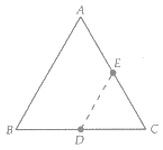
- zero
- \(\frac{3 q Q}{4 \pi \varepsilon_{0} a}\)
- \(\frac{3 q Q}{8 \pi \varepsilon_{0} a}\)
- \(\frac{q Q}{4 \pi \varepsilon_{0} a}\)
Answer
(A) zero
Sign up free on Edukali to view the step-by-step worked solution and practice thousands of similar questions.
Related practice questions
- An isolated conductor, with a cavity, has a net charge +Q. A point charge +q is inside the cavity. The…
- Given two hollow spherical conductors A and B as shown in the figure. Points M and N can be connected by…
- Two spherical conductors A and B of radii a and b (b> a) are placed concentrically in the air. The two are…
- The figure shows four pairs of parallel identical conducting plates, separated by the same distance 2.0 cm…
- The angle between the electric lines of force and an equipotential surface:
- Two thin dielectric slabs of dielectric constants _1 and _2 ( _1 < _2 ) are inserted between plates of a…
- A point charge of 20 nC is fixed at the origin of x-y plane. The work done in taking a second point charge of…
- Two capacitors of 10 F and 20 F are connected in series with a 30 V battery. The charges on the capacitors…
More Electrostatic Potential & Capacitance questions · Browse all practice questions