One end of a long metallic wire of length L is tied to the ceiling. The other end is tied…
Physics · JEE Advanced · NTA Exams — Oscillations and Waves
One end of a long metallic wire of length L is tied to the ceiling. The other end is tied to a massless spring of spring constant k. A mass m hangs freely from the free end of the spring. The area of cross-section and the Young’s modulus of the wire are A and Y respectively. If the mass is slightly pulled down and released, it will oscillate with a time period T equal to
- 2p(m/k)1/2
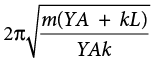
- 2p(mYA/kL)1/2
- 2p(mL/YA)1/2.
Answer
(B)
Sign up free on Edukali to view the step-by-step worked solution and practice thousands of similar questions.
Related practice questions
- A particle of mass m is executing oscillations about the origin on the x -axis. Its potential energy is V ( x…
- A particle is vibrating in a simple harmonic motion with amplitude 4 cm. At what distance from the…
- Assertion (A): All oscillatory motions are necessarily periodic motion, but all periodic motions are not…
- One end of an ideal spring is fixed to a wall at origin O and the axis of spring is parallel to x-axis. A…
- A sonometer wire resonates with a given tuning fork forming standing waves with five antinodes between the…
- A long string having a cross-sectional area 0.80 mm 2 and density 12.5 g/cm 3 is subjected to a tension of 64…
- A transverse wave is described by the equation The maximum particle velocity is equal to four times the wave…
- Two periodic waves of amplitudes a and b pass through a region at the same time and in the same direction. If…
More Oscillations and Waves questions · Browse all practice questions