For a first order reaction A ( ~g ) 2 ~B ( ~g )+ C ( ~g ) at constant volume and 300 K…
Chemistry · JEE Advanced · NTA Exams — Chemical Kinetics
For a first order reaction \(\mathrm{A}(\mathrm{~g}) \rightarrow 2 \mathrm{~B}(\mathrm{~g})+\mathrm{C}(\mathrm{~g})\) at constant volume and 300 K, the total pressure at the beginning (t - 0) and at time t are \(\mathrm{P}_{0}\) and \(P_{t},\) respectively. Initially, only A is present with concentration \([\mathrm{A}]_{0},\) and \(t_{1 / 3}\) is the time required for the partial pressure of A to reach 1/3rd of its initial value. The correct option(s) is (are) (Assume that all these gases behave as ideal gases)
(2018)
(2018)
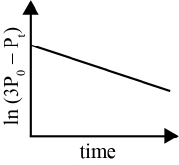
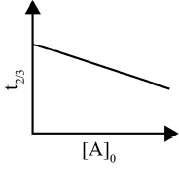
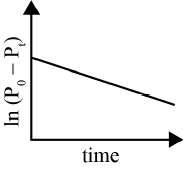
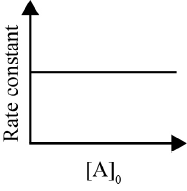
Answer
(A) , (D)
Sign up free on Edukali to view the step-by-step worked solution and practice thousands of similar questions.
Related practice questions
- For the reaction A + B → C + D, the variation of the concentration of the product with time is given by the…
- SO 2 C l 2 ⇌ SO 2 + C l 2 is the first order as gas reaction with k = 2.2 × 10 –5 sec –1 at 320ºC. The…
- The half-life a first order reaction is 24 hours. If we start with 10M initial concentration of the reactant…
- If a reaction A + B → C is exothermic to the extent of 30 kJ/mol and the forward reaction has an activation…
- Consider a reaction aG + bH → Products. When concentration of both the reactants G and H is doubled, the rate…
- When the temperature of a reaction is changed from T 1 to T 2 half-life is found to decrease. Thus :
- The half-life period for a reaction at initial concentrations of 0.5 and 1.0 mol lit –1 are 200 sec and 100…
- A radioactive element gets spilled over the floor of a room. Its half-life period is 30 days. If the initial…
More Chemical Kinetics questions · Browse all practice questions